I'm typing these very letters and words from the giganormous University of Texas at Austin library. I don't even know what this thing's officially called, but it's so big, it probably has three names. Looking over my shoulder, I can see computer terminal #129 all the way in the back of the room. This ain't no Richland College lib'ary, my friends. This is the real deal.
As someone who has been accepted to UT, I have the awesome privilege of using my electronic identification number (or EID as they say around here) to sign in to the uni's computers. Nice, especially since I haven't given UT a gosh-darn dime, registered for a single class, or even payed the deposit. Yet here I sit, using this fine academically-purposed Dell (by the way, Blogbarger, the faculty get Macs around here for some reason) for something purely un-academic.
Welp, I should probably track down that philosophy advisor before he takes off for the weekend. Hook 'em...us!
Friday, June 22, 2007


Thursday, June 21, 2007
Sueños
 I'm really liking my new job. I love working with people again, serving others face to face, and providing a product I really believe in. In fact, this job is reaching into recesses of my mind that few others ever have.
A few nights ago dreamt that I was waiting tables at the Porch. I woke up in a half-daze and sat up on the end of my bed, believing I was sitting on a table at work. "Should I be sitting on a table when I have guests mid-meal?" I wondered. "And shouldn't I be wearing pants?"
A couple days later I dreamt that I was riding along in a car with some of my co-workers when we got pulled over. Instead of giving the cop his license and insurance, the driver grabbed a gun, gut-shot the man, and drove us off down the road. I don't remember who else was in the car, but the driver happened to be the one person I work with that's made a racist comment since I've started. I wonder at the psychology of that coincidence.
And lastly, two days ago, I woke up in the middle of the night anxiously wondering if I really ought to be dozing when I had open checks on the tables. Then I realized it might be a dream. But I had to deliberately reminded myself of each individual check that I had closed at the end of the night before I could drift peacefully back to sleep.
Saturday, June 09, 2007
Ready to Give Up
On web browsers doing what they're supposed to do. Firefox delets my bookmarks every time it installs an update; the "back" button on IE takes me to pages I've never visited. Netscape is dead (but it was ugly even in life). Opera...sounds a little fay. Does Safari work on a PC?
Monday, May 28, 2007
Update: An Open Invitation
Or: "When I Look at the Television, I Wanna See Me Starin' Right back at Me."
I got pretty bummed when I found out I'd be working the high-top tables in the bar tonight. Self-seating at these tables means less food and more drinks, often ordered at the bar. That can equal a lot of work and not a lot of reward.
I didn't make much money, but I did luck out. TXA 21 came by to do a profile of the Porch and they sat in my section. Plus, super chef and co-founder Nick Badovinus was working and I got to interact with him throughout the night. Of course, the TXA people loved the food. And I got some camera time. Tune in Sunday at 6pm for a show called "DFW 10" to check it out.
I work Wednesday (the 30th), Sunday, and Monday. I hope to see you soon!
Tuesday, May 22, 2007
An Open Invitation
 Alright, guys, I'm hoping to make you an offer you can't refuse. I just got hired at the Porch, the latest buzz-worthy Simon/Badovinus restaurant. I wait tables and I need practice. I don't want to be the guy who forgets to refill Mark Cuban's water glass next time he comes in. So here's the deal: Come in and have a meal at the Porch, request me as your server, and be my very own VIP. Our food is fabulous, the kind of stuff mom would make if she were an executive chef. Here's the kicker: you don't have to tip me. No, you don't. If you come to my restaurant, don't you dare tip me. I just want to see some friendly faces.
Come on over and have some brisket sliders, a grilled three-cheese sandwich and a cup of homemade tomato soup or a plate of braised short rib stroganoff. Or grab a 14oz cut of medium-rare prime rib and side of smoked ham mac'n'cheese to share. And give our farmer's market cobbler a try before the peaches go out of season. Sandwiches start at $10. I work tonight (the 22nd), Thursday (24th), and Sunday (27th). We open at 5; here's the map.
Tuesday, April 24, 2007
Tired
I’m tired.
I’m tired of being physically worn out, sleepy, spent. I’ve exhausted every desirable permutation at Starbucks and can’t drink Gachet’s swill anymore.
I’m tired of procrastinating. I’m tired of last-minute, late-night, half-assed (or less) efforts. I’m tired of substituting Amp for sleep. I’m tired of turning in rough drafts the day the finished product is due.
I’m tired of being unable to express it. I’m tired of not being able to write about it. I’m tired of making a concerted effort to avoid “be” verbs, of employing alliteration (it’s a cheap trick), and of relying on a thesaurus. Tired of reading shit on the internet that’s written in passive voice and of wondering if I’m really any more talented than the jokers who contribute awful prose to Wikipedia. I’m tired of censoring myself. I’m tired of being slow to speak, slow-witted, a slow reader, and slow at my work.
I’m tired of waking up three days a week and doing a lonely job that only sorta pays. I’m tired of not being a morning person, of starting late and lazily ending early. I’m tired of slowly losing my sanity—laboring alone with my only thoughts and fragments of Fergie songs stuck in my head.
I’m tired of apologizing to my Lord every time I utter the word(s) goddamnit. I’m tired of saying goddamnit. I grow weary of trying to not sin, of forever losing the same battles, of my sinful nature. Mostly I’m tired of seeing large breasts with delicate, translucent skin poised to burst out of tank tops and partially unbuttoned blouses and so tired of trying not to stare.
I’m tired of these eyes that don’t see clearly, these yellow teeth, these knobby knees. I’m tired of this flesh.
I’m tired of struggling to form thoughts in a cloud, the meaning always hidden just beyond the fog. I’m tired of having to hear an idea, watch a film, or read a poem twice just to identify the subtleties that everyone else sees. Tired of being powerless to form a decent question or original thought.
And I’m tired of losing points when I do get it right—when I omit a comma after an introductory “and” or answer that Nixon wasn’t formally impeached. Tired of being rebuked, attacked, or punished on the rare occasion that I assert myself, go with my gut, or say what I really feel. I’m tired of being misunderstood, of being incapable of making you understand. I’m tired of my own self-protection, my own distrust.
Tired, too, of wanting to cry and remaining unable or unwilling to. I’m tired of feeling sorry for myself when friends are uprooting families and crossing oceans, when family members are counting the days until parents die, and when friends of friends are running from emotional abuse. I’m tired of being helpless to Free Tibet, Save Darfur, save even a single soul, or do positively anything else worth a damn. I get uncomfortable talking for more than ten minutes about anything that will perish with this world.
I’m tired of not knowing what to do with myself, of not wanting to work hard enough to contribute anything. Of my lack of passion. Of not being the Cool One, Talented One, or Fun One.
Guys, I’m tired of uncertainty, of not knowing the future but having to make decisions that affect it. I’m tired of making decisions based on money. Tired of being too poor to afford more than two pints a month at the Ginger Man.
I’m tired of only eating food that can be microwaved at home. I’m tired of fried food everywhere else. Tired of worrying about calories.
I’m tired of bitching. I’m tired of being all talk and no action. I’m tired of writing “I’m tired.” It must be awful to read.
I need a vacation.
Sunday, March 18, 2007
So Fresh I'm not sure what to Make of It
Tonight, whilst perusing the Drudge Report, I clicked on a link promising a video--unauthorized by Barack Obama but allegedly produced by his minions--analogizing Hillary Clinton to Big Brother a la 1984. What I got was Apple's Macintosh introduction commercial reworked with Clinton's face and voice in place of Mr. Brother's. Here's the video:
The ad would have been extremely effective except for one thing: I tend to deconstruct advertising, and something in the video caught my eye and distracted me completely. Right around the 41st second, I noticed something that could not have possibly been in the original Apple commercial--in the Clinton version the Runner wears what looks like an iPod on her waist. There's no way Apple was working on anything resembling the iPod back in '84, right?
I checked the original, and the iPod does not appear. Of course it doesn't. But somebody sure put forth a lot of effort to get it into the new one. Are we looking at new footage or frame-by-frame Photoshopping? More importantly, why add it to a political piece at all? What kind of conspiracy are we dealing with here?
 The original Apple ad (L) and the same frame from the modified version.
Monday, March 12, 2007
Move Over, Mii
Oh, the joys of console gaming. One never knows which one to buy. If you want HD graphics with the potential to wander into the Uncanny Valley plus a built-in Blu-Ray player, the Playstation 3 is the only way to go. If you want fun, motion-interactive games a grandmother could play, the Wii's your best bet. If you frown on floating-point calculations and prefer a GPU with L2 cache, an HD-DVD add-on option, and you're addicted to Halo, why Microsoft has a nifty little box called the 360 you might want to check out. Choosing just one system proves difficult, because there are so few points of comparison.
 But a few exist. Sony and Nintendo noticed the raging success of Xbox Live and created their own online networks. Nintendo's Wii even introduced customizable characters that serve as proxies in certain games. They resemble cute, animated weebles as they hop toward fly balls and bounce around tennis courts. I thought the concept was clever even though function clearly took priority over form. And then I saw this video.
 But a few exist. Sony and Nintendo noticed the raging success of Xbox Live and created their own online networks. Nintendo's Wii even introduced customizable characters that serve as proxies in certain games. They resemble cute, animated weebles as they hop toward fly balls and bounce around tennis courts. I thought the concept was clever even though function clearly took priority over form. And then I saw this video.
Thursday, March 01, 2007
Darn Unreliable Sixth Sense
 My sixth sense failed me today, in a pretty significant way. No, I'm not talking about that sixth sense. I'm talking about the real one: the ability to sense where the parts of one's body are. There's no slick monosyllabic word for this sense, and that's probably why it hasn't been added to the list of sight, sound, touch, taste, and smell. It's real nonetheless. It's the sense that allows you to close your eyes, stretch out your arms, and touch your index fingers together (go ahead, try it--I just did).
Anyway, as I surveyed my first pool today, I cursed the wind storm that had deposited a layer of dust on the plaster of every single on of my pools. The dust means I have the awesome privilege of vacuuming every square inch of every pool--doubling the amount of work it takes to get the job done. I thought it couldn't possibly get any worse. But a little bit later I was transferring leaves from my pool serviceman's net (or "rake" as we say in the biz), things got worse as sense numero seis let me down.
I readjusted the placement of my right foot and stepped not on solid ground as I had expected, but in seven-foot-deep water. Time slows down when you're a pool serviceman and you realize you're about to go all in on a watery hand. I quickly realized what was happening and had just enough time to think "oh gosh, this is the big one, the one that ruins my cell phone" and desperately lean to the left. The slow-motion lean did the trick. It was not "the big one." Only my right leg got soaked. Disaster averted. Final verdict: squishy sock for the rest of the work day (my backup socks were in the laundry).
Wednesday, February 28, 2007
SNL Digital Shorts
If Saturday Night Live stopped going live and converted the entire 90 minutes to Digital Shorts, I think they'd have a real hit show on their hands. Whoa, that sentence reads like a Jackie Harvey column. Anyway, here's the latest:
Check out that last shot. Some of you might recognize it.
Check out that last shot. Some of you might recognize it.
Thursday, December 21, 2006
Christmas Grumblings
 I'm not a big fan of the Christmas season. It stresses me out. I don't know whom I should buy gifts for, how much I should spend, or what to purchase for the few lucky souls that I deem worthy of my munificence. I loath the cultural takeover America has pulled on Christmas.
Celebrate Christ's birth? Sounds like a great idea to me, maybe something the reverent should emphasize more on a daily basis and dissassociate from a single, arbitrary day. Give gifts to remind each other of God's gift of salvation to us? Yes! I'm down with that, but why do we feel pressured to go into credit card debt to do so? I'd rather give (or get) one thoughtful gift than several pricey ones.
The drive to shower each other with presents compels us to drive to the malls where we realize that everyone else in the city has decided to meet us there for some fun "crowding around the Rock/Pop A-D section" and "standing in check-out lines." The worst part of this arrangement, however, is the soundtrack.
I don't like Christmas music, folks. Now I do enjoy singing the occasional "Joy to the World" or the "cradle song" version of "Away in a Manger" (but who knows that one anymore?) one Sunday morning out of the year, but the rest of it stinks. I got "Winter Wonderland" stuck in my head the other day when I was cleaning pools and seriously contemplated putting my finger in a spinning impeller just so I could have an excuse to go home. The most vile Christmas tune ever perpetrated upon the innocent public, however, has got to be "Feliz Navidad." What a pretentious piece of tripe! That tune is so horrible yet catchy, and the way the lyrics are sung with an affected Spanish accent just grates on the intellectual nerves. (Gary Wabshaw, wherever you are, I hope God makes a special place in purgatory for you. Thanks to you, I cannot listen to "Feliz Navidad" without mentally singing "Fleas on My Dog").
Fortunately, back in 1965, Charles Shultz hired the Vince Guaraldi Trio to come up with some music for "A Charlie Brown Christmas." That music remains fresh and fun forty years later. It redeems (although I wouldn't say justifies) the whole awful Christmas genre. I love it. I don't know why I haven't bothered to buy a copy.
Time for me to do some shopping! I almost look forward to it. Why? Because I am blessed to have several people in my life who not only give thoughtful gifts, but several thoughtful gifts (I'm talkin' 'bout you, Amanda--and others). The kindness of my friends and family inspires me to give back and pay forward. That's my motivation to wade through the Christmas crap.
Tuesday, December 12, 2006
Deep Thoughts, by Jack Handy
Contrary to what most people say, the most dangerous animal in the world is not the lion or the tiger or even the elephant. It's a shark riding on an elephant's back, just trampling and eating everything they see.
As we were driving, we saw a sign that said "Watch for Rocks." Marta said it should read "Watch for Pretty Rocks." I told her she should write in her suggestion to the highway department, but she started saying it was a joke - just to get out of writing a simple letter! And I thought I was lazy!
One thing kids like is to be tricked. For instance, I was going to take my little nephew to DisneyLand, but instead I drove him to an old burned-out warehouse. "Oh, no," I said, "DisneyLand burned down." He cried and cried, but I think that deep down he thought it was a pretty good joke. I started to drive over to the real DisneyLand, but it was getting pretty late.
Monday, December 04, 2006
Forget Santa Claus...

The greatest 80s band ever--Styx--is coming to town. (Props to my wonderful girlfriend Amanda for the heads-up). Now you might disagree with me about their precise status as the greatest, but who can deny the alternatively relaxing and rocking power of "Come Sail Away"? Who can listen to "Lady" without being moved? Who can resist the awesome persuasion of "Mr. Roboto"? Who among us has cannot identify with having "Too Much (clap clap) Time on [Our] Hands"? Styx dives into our souls and surfaces to express our most basic needs--"Gimme a job, give me security"--and our innermost spiritual desires--"Show me the way/Take me tonight to the river and wash my illusions away!"
Oh Daniel DeYoung, what angelic vocal overtures! Oh the depths of the riches of the wisdom of using synthesizers to rock!
Those of you who would not deign to give audience to Nugent (I guess that would be all of you), now is your chance to redeem yourselves. Join me in Fort Worth on January 20th for a night you will not soon forget. A paltry $12 is all you need to experience the magic. To paraphrase Ray Stevens, put your cares on ice--it's cheap at twice the price.
Monday, November 27, 2006
Great, Meaningful Moments in Modern Art (Continued)
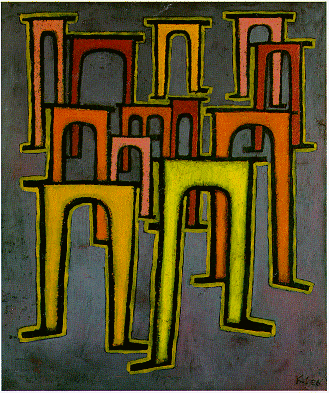
 I gotta say that I was being completely sincere when I ascribed the words "great" and "meaningful" to Paul Klee's "Revolution of the Viaduct." There are only simple shapes and colors on the canvas, but is that all there is to this work? Upon closer examination, the painting reveals more than meets the eye. It seems that Klee (pronounced "clay") might have been trying to say something about individuality and non-conformity, possibly in response to the rise of the Nazi party in his homeland, Germany.
 Each shape resembles a cut-away section of an ancient Roman aqueduct. Each differs from the others in size, shape, color, and apparent distance from the viewer. But Klee gives us clues that he is thinking beyond mere geometry and perspective here. The serifs at the bottoms of the figures are reminiscent of feet, and transform the columns into legs. The differing lengths of the legs create the illusion that the figures are mobile, and they are coming toward us.
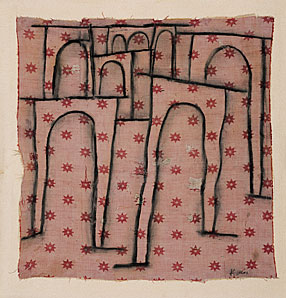 It would seem, then, that the arches are standing in for people, but why did Klee choose to paint human beings instead? His visual subject must be considered. Roman viaducts were rigid structures comprised of dozens or hundreds of columns and arches—all uniform in size and shape. Each arch yielded itself to the whole, and the structure was strong as a result. As an allegory to society, the ancient viaducts meant glorification of the whole and de-emphasized the individual. Klee seems to be suggesting something different: that society consists primarily of individuals.
Each figure is individual; no two are alike. Their different postures and varying degrees of motility suggest attitude and will. Klee has constructed a society that values the individual and is only loosely unified. His society derives strength from its diversity, however, and the gold, warm colors and illusion of motion suggest that it is advancing toward us, irresistibly and inevitably. Furthermore, his figures may do as they please, and while they do march toward us as a group, they will not be conformed. These seem to be the major themes of the work: individuality, non-conformity, and celebration of strength in diversity.
 Klee might also have been responding to German National Socialism (he painted the work in 1937-38). His arches defy the Nazi ideal of a homogenous super-race. The arches also stand in contrast Nazi architect Albert Speer’s uniform design of the 1936 Olympic Stadium in Berlin. Finally, the title of the painting might be a twist of Nazi propagandist Heinrich Himmler’s statement that the Bolshevics and Jews made up a “revolution of subhumans.”
Klee once said his goal was to paint the human spirit. In “Revolution,” he has done it as a celebration of individuality and a rejection of all that would quash it.
Thursday, November 16, 2006

Thursday, November 09, 2006
BodyFlex Daily Workout
I would like to thank Kristin Agrimson for bringing this to my attention (she stole the VHS from her mom back in the day).
It'll be the next Tae-Bo!
It'll be the next Tae-Bo!
Wednesday, November 01, 2006
Bye Bye Barker
 After fifty years in television (thirty-five of those on The Price Is Right), Bob Barker has announced that he is stepping down. The 83-year-old will retire in June of 2007. Now, I've thought he's been pretty cranky the past few years, but I get all misty-eyed at the thought of a Barkerless TPIR. It was hard enough to lose Rod Roddy; I grew up with both of these guys. I gotta buy myself a ticket to LA and witness the magic while I still can. The Dice Game, Plinko, and Hole-In-One just won't be the same without good ol' Bob.
Monday, October 16, 2006
Spoonus: Conclusion
 Spoonus: But I still doubt that our souls exist prior to birth. We could be given the knowledge at the moment of birth, as Simmias said.
Socrates: But at what other time do we lose it? Do we lose it at the very time we acquire it, or can you mention any other time? If those realities which my friends and I were always talking about exist (and we know with certainty here in the afterlife that they do), the Beautiful and the Good and all that kind of reality, and we referred all the things we perceived in the body to that reality, so the soul must exist before we are born.
Spoonus: But what if we do not forget our knowledge in the first place? Let us consider those things which are absolutely knowable: Justice, Beauty, Goodness, and the like. When does a person recollect what Justice is? When he is mature? Or does not even a child know? If children did not know what Justice was, would they be forever tattling on each other? And are not children drawn to that which we call Beautiful, and attempt to exemplify beauty in their artwork? And do not even infants know what is Good? Immediately after birth, a baby knows that his mother’s milk is good.
Socrates: What you say might be true, but can an infant demonstrate any knowledge of mathematics? Of course he cannot, because he has forgotten it, and has furthermore forgotten how to speak!
Spoonus: He might not know anything about the higher orders of mathematics, but he certainly knows what “more” and “less” are when he is fed. The difference between his knowledge and that of Pythagoras is in his ability to articulate his knowledge, or perhaps in the extent of the potential of his knowledge. By potential, I mean that which can come about, but which has not yet.
Socrates: Which is it? According to you, either he has full knowledge, and cannot articulate it, or he has potential knowledge, which seems to be no knowledge at all, but I am not sure which you mean.
Spoonus: I say it is both. I hope you are not weary of hearing about Meno’s servant, because I would like to refer to him once more. I submit to you that he, being given the knowledge at birth, was given full potential knowledge, contained somewhat like a full oak is contained in an acorn. However, he could not articulate it. As he grew up, he acquired the means of articulation. When you questioned him, the potential knowledge was realized in his mind, and became actual, verifiable knowledge which he articulated in response to your inquiries. So he had not forgotten it; it had merely not been actualized. Therefore, the articulation of his knowledge does not prove that he knew anything before birth, only that he had knowledge at birth. Therefore, one cannot prove that the soul is eternal.
Socrates: On the contrary, in this case you have only argued that the soul does not exist before birth, and have said nothing about the state of the soul after death. Have you read my other excellent proofs of the existence of the soul after death, such as the Argument from Opposites or the Argument of the Form? Look at it another way: if the soul does not exist after death as you have stated, how then is it that you are here in Elysium talking to me?
Spoonus: By Zeus, I don’t know! However, I have read your proofs, and it seems that since our souls will never perish, we should have adequate time to discuss them. We must also inquire as to how something could have a beginning, but no end, and furthermore, if the soul is given knowledge at its beginning, what or who gives that knowledge. What is rent like at the
Thursday, October 05, 2006
Spoonus, Part I
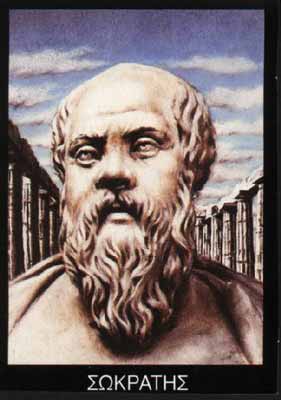 The Spoonus, also known as The Socratic Soul, is the most recently discovered Socratic dialogue. Spoonus was a student of Socrates (via Plato’s writings), and has recently died; his soul transmitted to the underworld. He wishes to question Socrates regarding the philosophy of the soul that Socrates maintained in life. Spoonus’s soul arrives in Elysium, where the soul of Socrates has resided since his execution, although he plans to move into the Tower of Cronos as soon as the Form of his Credit Check is processed (although in his case it is probably just a formality). Spoonus arranges to meet with Socrates before he leaves Elysium. Scholars disagree as to whether this is an account of the historical Socrates, or whether the writer, possibly Spoonus himself (or his reincarnated soul) is putting words in Socrates’ mouth.
SPOONUS: Hello, Socrates. It is indeed an honor to have an audience with you. I am sorry I am late; Charon did not have change for a drachma.
SOCRATES: You are outrageous, Spoonus. Have you come to converse with me about the journey hither? Or have you come to inquire of me, as Meno, Crito, and others did in life? Surely, as a soul freed from the body, you know everything, and there is no knowledge which I can impart to you.
SPOONUS: Perhaps there is. You once said that “we must at some previous time have learned what we now recollect.” If we learned before life what we recollect in life, we must have lacked knowledge before we learned it as souls, for to learn is to acquire knowledge, and how can one acquire what one already has? So perhaps there remains something I can learn even now. At the very least, help me to recollect the words you spoke in life.
SOCRATES: I will certainly attempt to do so.
SPOONUS: I am interested in your ideas about the soul. As I understand it, you once proved that the soul is eternal by demonstrating that a servant boy, who had no apparent knowledge of geometry, could arrive at a correct mathematical conclusion without any instruction at all. That is to say, the boy had knowledge which he had not been taught. If he had this knowledge, he must have known it before birth and forgotten it, but you helped him “recollect” it.
SOCRATES: What you say is true. In fact, all knowledge obtained in the body is recollection. For when men are interrogated in the right manner, they always give the right answer of their own accord, and they could not do this if they did not possess the knowledge and the right explanation inside them.
SPOONUS: So then, if men are not interrogated in the right manner, they might not give the correct answer?
SOCRATES: To speak of a right manner implies a wrong manner, so what you say might be true.
SPOONUS: Let us explore, then, the correct manner of interrogation. In questioning the boy, you asked him what the dimensions would be of a square with an area of eight feet, based on the knowledge of the dimensions of a square with an area of four. You said, “The side of this is two feet. What about each side of the one which is its double?” He replied, “Obviously, Socrates, it will be twice the length.” Clearly, he was incorrect. You questioned him further, he saw his error, and he arrived at the correct dimensions.
SOCRATES: It happened exactly as you say. I did not teach the boy anything, but all I did was question him.
SPOONUS: But as to the “correct” way of interrogation, you knew the correct answer, and so were able to ask him questions that aided his “recollection.” Did you not lead him in your questioning? Would you not say that the “correct manner” is merely that by which the knowledgeable leads the unknowledgeable, and is that not teaching?
SOCRATES: I did not lead him; I only asked him questions about what was true. He merely recollected things in order, from the more simple principles of linear doubling to the more complex principles of two-dimensional doubling.
SPOONUS: Yet if you had not known, or recollected, the answer yourself, would you not have been unable to interrogate him correctly? If someone who lacked knowledge, like Euthyphro, had questioned him, would it not have become apparent that the boy could not recollect the truth, and at best could recollect only part of it? And does it not seem that he “recollected” both truth and falsehood? As a student of Euthyphro he would have learned or recollected nothing wholly true. Therefore, you did teach him.
SOCRATES: On the contrary, whether I had continued questioning him or not, if the boy was philosophically inclined, he would have questioned himself, and demonstrated to himself the correct answer. He would have recollected it on his own without my influence, although it might have taken him some time. Therefore, all learning, whether under a tutor or on one’s own, is recollection. And if it is recollection, then knowledge exists in the soul before birth, and the soul is eternal. We must recollect what our souls know, however, because we forget it when we are born.
Tuesday, September 19, 2006
Anna vs. Charlie
When I’m not in a classroom learning about Platonic Forms or about the difference between a disk and a disc, I clean pools to finance my education. Pool cleaning is a solitary job; the pool serviceman drives alone from back yard to back yard with his tools and equipment, with no companion other than the hot Texas sun and the mediocre Dallas radio. But some stops along the way are not so lonely. Sometimes there is a dog. On my route, there are two.
When I met Anna, I was unprepared. I drove my truck to the back gate and swung it open. She was waiting for me, a knee-high, short-haired, caramel-colored canine of a breed I’d never encountered. I quickly shut the door expecting an attack or an escape attempt. But I had misjudged her. I soon learned that Anna didn’t want to run away, and she didn’t even make a sound as I brought in my equipment. She just wanted to be near. She followed me around loyally, but if she dashed off to scare away some crows, she’d come back when I called (I learned her name from her tags). She would chase a ball if I threw it, too. In the ensuing weeks, Anna became my friend—sweet, but never smothering. I started to like the idea of working with dogs.
And then I met Charlie. (Charlie’s real name has been withheld for the sake of his own dumb innocence.) I met him a few weeks later in a different neighborhood. Weighing in around 45 pounds, he has long, black hair and an aborted tail. Charlie is the out-of-shape co-worker you wish wasn’t in the cubicle next to yours. The first thing one notices about him is the smell: pure odeur de chien humide, which he maintains by periodically wading in the pool. He breaths heavily upon the slightest movement, or anytime he’s standing, or anytime he’s just lying around. And he likes to stick his nose in my business: “Is that a tennis ball in your pocket?” Whenever I have to walk back to the truck for supplies, Charlie follows, until we head down the stairs; inertia then takes over and propels him ahead of me. He eats every chance he gets. I would give him points for loyalty, but since his particular brand means remaining within 15 feet of me, it means I can always smell him, and his only asset becomes void. He won’t be told to leave, either. His b.o. and behavior really strain our relationship.
My relationship with Anna is blissful, however. She’s a saint. If I could, I’d take her home with me. I’d take Charlie with me if I could, too, but I’d set him free somewhere outside the city limits, where nobody would smell him. He’s a real son of a bitch.
Subscribe to:
Posts (Atom)